
Voice Modulation & Dialogue Delivery: Skills Every Actor in South Punjab Needs

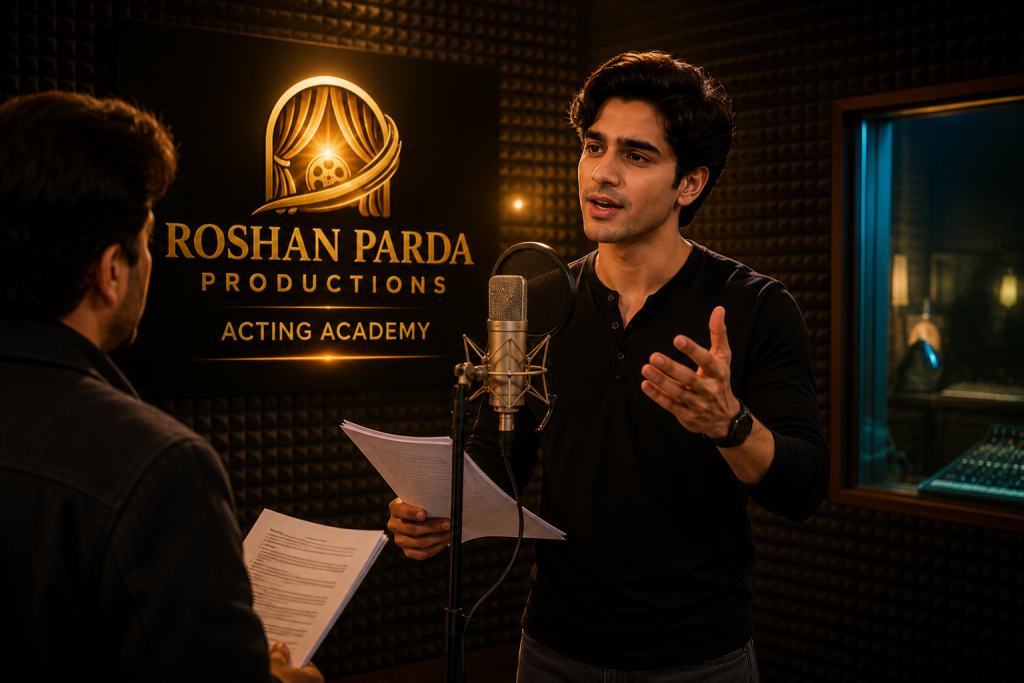
Watch any scene where an actor genuinely convinces you, and you’ll notice something: it’s rarely just the words. It’s how those words are said — the pause before a hard truth, the crack in a voice during grief, the sudden sharpness in anger. That’s voice modulation and dialogue delivery, and it’s the single most underrated skill gap among new actors in Multan and South Punjab.
Most beginners focus entirely on memorizing lines. Professionals focus on how those lines are delivered. This article breaks down exactly what voice modulation is, why it matters more than raw talent, and how you can start training it — even before you join a formal acting class.
What Is Voice Modulation, Exactly?
Voice modulation is the controlled variation of your voice’s pitch, pace, volume, and tone to match emotion, intention, and context. It’s the difference between reading a line and performing it.
Say the sentence “I’m fine” three different ways — flat and dismissive, shaky and unconvincing, sharp and defensive — and you’ve just demonstrated modulation. Same words, three completely different meanings. This is the tool that lets an actor communicate subtext without ever changing the script.
Why This Skill Matters More Than People Realize
New actors often assume that looking the part or memorizing lines quickly is what gets you cast. In reality, casting directors and directors are listening for control. A flat, monotone delivery — no matter how well-memorized — signals inexperience instantly.
For actors coming from South Punjab, where Urdu is often blended with Saraiki or Punjabi inflections, this skill is especially important. It’s not about erasing your natural accent — it’s about gaining full control over your voice so you can shift it deliberately, whether the role calls for a regional dialect or standard Urdu delivery.
The Core Components of Dialogue Delivery
1. Pitch Control
Pitch — how high or low your voice sits — communicates emotional state before a single word registers. A lowered pitch reads as calm, authority, or menace. A raised pitch reads as excitement, panic, or youthfulness. Actors train to shift pitch intentionally rather than letting nerves dictate it.
2. Pacing and Pauses
New actors tend to rush through dialogue, especially when nervous. Professional delivery uses pace as a tool — slowing down to create tension, speeding up to convey urgency, and using silence (a well-placed pause) to let a line land emotionally.
3. Volume and Projection
This isn’t just about being heard — it’s about controlled intensity. Shouting isn’t the same as projecting anger; a quiet, controlled voice can carry far more menace than volume alone. Projection training also matters practically for stage work and live recording environments.
4. Breath Control
Every actor eventually hits the same wall: running out of breath mid-line, or having a voice that shakes under pressure. Breath control training — the same techniques singers use — gives actors the stamina to deliver long monologues without losing vocal steadiness.
5. Tonal Shifts Within a Single Scene
The most advanced skill is shifting tone mid-scene as a character’s emotional state changes — moving from calm to breaking point within the same conversation, without it feeling abrupt or forced.
Simple Exercises Beginners Can Start With
You don’t need a formal class to start building awareness. Try these:
- Record yourself reading the same line five different ways — angry, sad, sarcastic, fearful, joyful — and listen back
- Practice the “whisper to shout” scale — read a sentence starting at a whisper and gradually building to full volume without straining
- Read news headlines like dialogue — practice turning flat, factual text into something that sounds like it has emotional stakes
- Breathing drills — inhale for four counts, hold for four, exhale for four, to build the breath control needed for longer deliveries
These exercises build raw awareness, but real correction — the kind that catches habits you can’t hear in your own voice — only happens with a trained instructor listening and giving direct feedback.
Why This Is Taught Early at Roshan Parda Acting Academy
At Roshan Parda Productions’ Acting Academy in Multan, voice modulation and dialogue delivery aren’t treated as advanced, later-stage skills — they’re foundational, taught from week one. The reasoning is simple: a student can memorize scenes and blocking later, but a voice that hasn’t been trained to control pitch, pace, and breath will limit every performance built on top of it.
Because the academy operates alongside an active production house, students also get to apply these skills in realistic dialogue and scene contexts — not just theoretical drills — which speeds up how quickly the training actually shows up in real performance.
Frequently Asked Questions
Can voice modulation be learned, or is it natural talent? It’s a trainable skill. Some people start with more natural range, but pitch control, pacing, and breath support all improve significantly with structured practice.
Will training change my natural accent? No — training gives you control over your voice, not a forced accent change. Many actors keep their regional inflection and use it as a strength in the right roles.
How long does it take to notice improvement? Most students notice more deliberate control within a few weeks of consistent practice, though full command over tonal shifts develops over months.
Do I need to be loud or naturally expressive to succeed? Not at all. Some of the most effective delivery is quiet and controlled. Volume is only one tool among several.
Start Training Your Voice the Right Way
Reading about voice modulation only takes you so far — real improvement comes from guided practice and direct feedback. If you’re serious about building a genuine acting career, this is one of the first skills worth mastering.
Join Roshan Parda’s Acting Academy in Multan and start building the vocal control that separates trained actors from amateurs — or get in touch to learn more about current batch timings.